
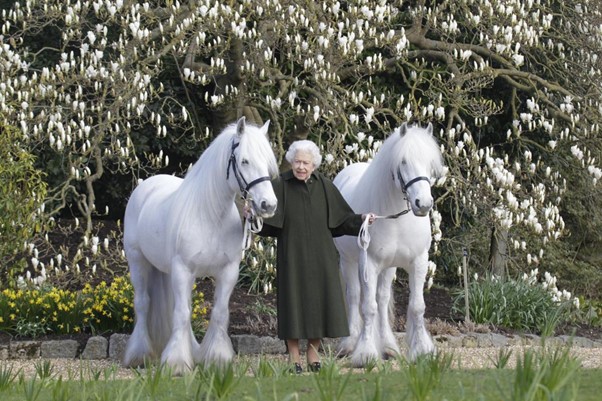
In her reign of 70 years, Queen Elizabeth II will be remembered as a remarkable icon of female leadership. Ascending the throne in 1952, during post-war austerity and reigning until her death in 2022, she witnessed enormous social change as well as progressing through the stages of her life – marriage, motherhood and maturity – in the continual glare of the public eye. She was not just the Head of State for the UK and 14 Commonwealth realms, but the head of the royal family – her own family, with her four children, eight grandchildren and twelve great-grandchildren.
Nuanced leadership
She was striking for her devotion to duty and her determination to dedicate her life to the service of her people, but her leadership role was nuanced, with the requirement to remain strictly neutral in political matters, whilst portraying the UK’s best values and traditions through a rapidly-changing world.
Elizabeth kept a formal public presence, but was known for her democratic leadership style, engaging the support of her people from the first. In her 21st birthday speech in 1947, she pledged her life to service of the nation, but expressed her humility and the value she put on collaboration, saying: “I shall not have the strength to carry out this resolution alone unless you join in it with me as I now invite you to do.”
Elizabeth lived up to that pledge for her entire life, and handled her leadership with both strength and grace. In a speech for the United Nations General Assembly in 2010, she said: “I know of no single formula for success. But over the years I have observed that some attributes of leadership are universal and are often about finding ways of encouraging people to combine their efforts, their talents, their insights, their enthusiasm and their inspiration to work together.”
“I know of no single formula for success. But over the years I have observed that some attributes of leadership are universal and are often about finding ways of encouraging people to combine their efforts, their talents, their insights, their enthusiasm and their inspiration to work together.”
Queen Elizabeth ii
She also proved herself willing to take on change and establish new ways, for example, approving changes to the succession laws in 2011 to allow the firstborn daughters to take precedence over their younger brothers, and witnessed the social paradigm start to shift towards empowering women, appointing not just the UK’s first female Prime Minister, Margaret Thatcher in 1979, but also Theresa May in 2016, and now Liz Truss in 2022.
Leading her own family has not always been easy either. In 1988 she commented: “Like all the best families, we have our share of eccentricities, of impetuous and wayward youngsters and of family disagreements.” The way she has traversed her own family life has also demonstrated her principles of leadership, including her famously strong relationship with her husband, Prince Phillip. In 1997, she acknowledged how deeply she relied on his support, commenting: “My husband has quite simply been my strength and stay all these years, and I owe him a debt greater than he would ever claim.”
Unique style
Queen Elizabeth’s leadership style has been forged in a unique setting encompassing being a young woman in a man’s world in the 1950s, through to a long-established matriarch in the 2020s. She has provided a role model for female leadership which focuses on leading through example, standing firm on principles and developing strong relationships. Elizabeth has proven that women can be strong and feminine leaders in their own right without needing to take on ‘male’ attributes or authoritarian behaviours. The personal brand she built was distinctive and graceful but not showy, and has provided a sense of stability, continuity, a rallying point for the nation – as well as being leavened with a wry sense of humour.
Queen Elizabeth II earned global respect through her dignity, decorum and discretion, and will be a leader remembered not just for her commitment and resolve, but also for her integrity on following through on her promises. On her Silver Jubilee, she recalled the pledge she had made 30 years before: “When I was 21, I pledged my life to the service of our people and I asked for God’s help to make good that vow. Although that vow was made in my salad days, when I was green in judgement, I do not regret, or retract, one word of it.”
For exclusive access to more stories like this, subscribe to our monthly newsletter