

When Veterinary Woman first met Shani Toledano in 2023, HT VET was just beginning to gain traction.
Three years and more than 40,000 scans later, the co-founder and CEO talks about what the data has shown, how the technology has sharpened, and why she still has human medicine in her sights.
In April 2023, Shani Toledano spoke openly to Veterinary Woman about the journey and challenges in creating her company. HT VET was in its infancy, the technology, Heat Diffusion Imaging (HDI), and AI algorithm was working, but it was early days.
Those days seem like a long way off now. HT VET’s scanner is clinics in the US, UK and Europe and Australia, and it has been used on more than 40,000 lumps. The original HT Vista has been replaced by a faster, wireless second generation, VISTA iQ. And as well as gaining customers, the company has also generated a large and growing dataset on canine skin and subcutaneous masses, collected in everyday practice.
So what has all that data revealed?
Most lumps are never tested
The first thing the data confirmed is that the majority of the lumps seen in practice do not go on to have an FNA. A new study published in October 2026 in Veterinary Oncology, led by HT VET’s Chief Veterinary Officer, veterinary oncologist Dr Gillian Dank looks at how often skin and subcutaneous masses are aspirated in everyday practice and it points to a significant gap.
Shani explains, “Vets know lumps should be sampled. The gap isn’t due to lack of knowledge, but a busy consult list, a lump that looks harmless, and an owner weighing up the cost of another test all come into play in the consult room. “Let’s keep an eye on it” is often a sensible call, but it’s also the gap that cancers can slip through. Instead, we give vets and answer in 40 seconds that can confidently inform their next steps.”
That gap is personal for her. Her father’s cancer had been growing for about five years before it was found, by which point it was too late. “For five years my father felt completely healthy while something was growing inside him. Nothing in the system raised a flag. I couldn’t accept that.”
More lumps tested, more cancers found
The early evidence suggests that giving vets a quick, needle-free first step changes what happens next. In HT VET’s April 2026 survey of 77 practices using technology, 91% said they were testing more masses and 74% said they were diagnosing more malignancies.
“The VISTA iQ has never been about replacing FNAs and biopsies” explains Shani, “and what we have seen is that the clinics that use our technology actually go on to perform more investigations and more mass removals. The VISTA iQ is doing exactly what we hoped it would – flagging more masses that may have potentially been left, and catching cancer earlier.”
The study showed an increase in procedures right along the diagnostic pathway, as 79% of practices reported more mass removals, 65% performed more biopsies and 51% carried out more FNAs.
Dr Ohad Barnea, Clinical Director at Tenafly Veterinary Center, puts it simply: “I use HDI to tell me what to do next.” A high-risk result prompts urgent diagnostics or removal. A low-risk result gives the vet and the owner confidence to monitor
Better data, better accuracy
The accuracy figures have also improved as the dataset has grown. HT VET’s first peer-reviewed validation study, published in Frontiers in Veterinary Science in 2023, looked at 664 masses. The algorithm identified malignant masses with 85% sensitivity and a 97% negative predictive value.
The latest study, also led by Dr Dank and published in Veterinary Sciences in September 2026, evaluated 1,010 masses in 669 dogs. Sensitivity rose to 92%, with a negative predictive value of 98% at an assumed 15% malignancy rate. In practice, that means when the scanner says a lump is low risk, it is right 98 times out of 100.
“We are data driven ourselves and we know that vets need to be able to trust the device. This is why constant improvement is always our goal, and we are thrilled to see the accuracy of the VISTA iQ improving over time” Shani says. “The HDI technology was completely novel. We knew that every material moves heat in its own way, including tumours, but nobody had turned that into a test before. That’s where we began, and the more scans we do, the better the modelling becomes.”
Beyond benign or malignant
The newest development goes further than a risk score. The recently published paper in Veterinary Sciences tested two new AI classifiers for the most common benign and malignant skin tumours in dogs, lipomas and mast cell tumours respectively.
For anyone who has aspirated a mast cell tumour without warning, the value is obvious. A flag means the vet can give antihistamine cover before sampling, plan early staging and give the owner a clear reason to go ahead. A negative result doesn’t rule out a mast cell tumour, though, so those masses still need investigating.
“As our technology learns and evolves, our aim is to give veterinary teams more information at the earliest stage of investigation,” Shani says, “The device is not a diagnostic tool, but the more information it gathers and can give, the better the case can be handled. It helps the vet decide which lumps to aspirate, biopsy or remove, and gives them a clearer way to explain that decision to the owner.”
A job for the whole team
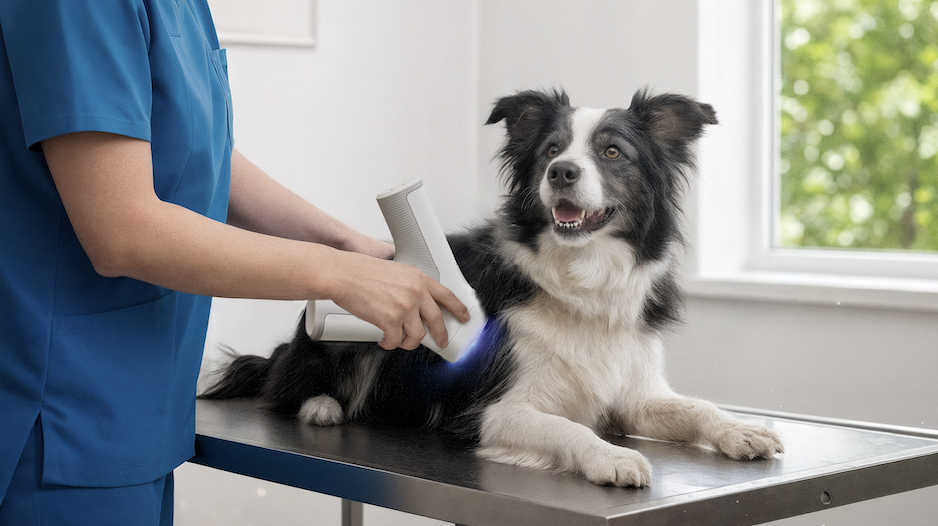
The scanner was designed to fit into a normal consult. VISTA iQ, launched in January 2026, is wireless, connects to a tablet or phone, and gives a result in around 40 seconds without sampling or sedation. A nurse or technician can run the scan, and a vet interprets every result before any decision is made.
Shani is excited about how the device can streamline workflows, “The VISTA iQ is a natural fit for nurse-led triage, an approach many practices are exploring as they look to make better use of their nurses’ skills. Nurses can prepare the patient and scan the mass, and if the dog needs to go on to see the vet, the information is all ready for them.”
Back to where it began
Despite the passion for the creation of HT VET being her father’s diagnosis and her desire to push human cancer diagnosis forward, Shani led the company into the veterinary industry first, with the plan to be to return to human medicine in due course.
The veterinary work has done more than build a business. It has given the technology real-world evidence and tens of thousands of scans to learn from.
“Every dog we scan is a family that gets more time,” Shani says. “But I never forgot where this started. The dream is still to bring this back to people. To the next healthy 50-year-old who has no idea what is happening inside him. That’s the promise I made, and we’re going to keep it.”
The HT in the company’s name still stands for her father’s initials. Three years on, thousands of dogs are already benefiting from the promise she made him.
VISTA iQ will be on Stand Y63 at London Vet Show, 19 to 20 November 2026.
Sources
- Veterinary Woman, 2023 profile
- Veterinary Sciences study;
- Veterinary Oncology FNA study
- HT VET clinic survey release (July 2025)
Both studies were funded by HT VET, and the company sees independent validation as the next step.
For exclusive access to more stories like this, subscribe to our monthly newsletter.
You may also like:
Shani Toledano – the woman behind the businesswoman
The Power of Intention – Veterinary Leadership in a Micro-Moment
Optimising women in veterinary leadership as a whole-organisation performance strategy